

Marketing operations analytics is the systematic measurement and optimization of marketing processes, technology, and performance to drive measurable business results. Unlike traditional marketing analytics that focuses on campaign performance, marketing operations analytics examines the entire marketing engine – from lead generation workflows to tech stack efficiency.
Key Components of Marketing Operations Analytics:
Many B2B marketers struggle with disconnected tools, messy data, and campaigns that can’t prove their worth.
Modern marketing teams juggle multiple different tools – sometimes dozens. Without proper operational analytics, this complexity creates more problems than it solves. You end up with data silos, manual reporting nightmares, and executives asking tough questions about marketing’s contribution to revenue.
The good news? Marketing operations analytics transforms this chaos into clarity. It helps you understand which activities truly drive results, where to invest your budget, and how to scale what’s working.
This guide will show you exactly how to build and implement a marketing operations analytics function that delivers real business impact – without the jargon or complexity.

Must-know marketing operations analytics terms:
Picture this: You’re running a marketing campaign that generates 500 leads, but only 12 turn into customers. While traditional analytics tells you about click-through rates and conversion percentages, marketing operations analytics digs deeper, revealing that your lead scoring system is flawed, your sales handoff process has a three-day delay, and your CRM integration is losing 15% of leads to a black hole.
That’s the power of marketing operations analytics. It’s not just about measuring what happened – it’s about understanding the why behind your marketing performance and building systems that consistently deliver better results.
Traditional marketing focuses on campaign performance metrics, such as email open rates, how to analyze traffic, and lead generation numbers. It answers questions like “How many people clicked our ad?” and “Which landing page converted better?”
Marketing operations analytics examines the entire marketing engine. Because it measures process efficiency, technology performance, and workflow optimization, marketing operations analytics answers questions like “Why does it take three weeks to launch a simple email campaign?” and “Where are we losing qualified leads in our system?”
The research on data-driven ROI shows companies using data-driven strategies achieve 5- 8 times higher ROI than those flying blind. But here’s what most marketing teams miss – having data isn’t enough. You need the operational framework to turn that data into consistent, repeatable results.
We’re operating in what feels like marketing’s perfect storm. The economy is hypercompetitive, digital change has accelerated everything, and stakeholders are demanding more accountability than ever before.
Your CEO wants to know exactly how marketing contributes to revenue. Meanwhile, your CFO is questioning every software subscription. And obviously, your sales team is complaining about the quality of leads. Sound familiar?
Modern B2B buyers expect personalized experiences across every touchpoint. They conduct extensive research before speaking with sales. They expect your content to be relevant, your follow-up to be timely, and your processes to be seamless.
Meanwhile, marketing teams are juggling more tools than ever. Each tool generates data, but without proper marketing operations analytics, you’re drowning in information while thirsting for insights.
Here’s where marketing operations analytics shines: It focuses on the operational metrics that traditional analytics entirely miss.
Workflow insights reveal the hidden time drains in your marketing operations. Instead of just measuring campaign performance, you’re tracking how long it takes to get campaigns live, where approval processes create bottlenecks, and which workflows could be streamlined or automated.
Technology performance goes beyond basic reporting to examine integration health, data quality issues, and platform ROI. After all, you’re not just using your martech stack; you’re optimizing it for maximum efficiency and minimal friction.
Process optimization measures your marketing operations against industry benchmarks. You’ll find what percentage of your team’s time gets spent on high-value strategic work versus low-value administrative tasks.
Cross-team alignment ensures marketing and sales are working from the same playbook. You’ll track lead definition consistency, handoff quality, and revenue attribution accuracy. No more finger-pointing between departments when deals don’t close.
This operational focus fosters continuous improvement loops rather than relying solely on campaign-by-campaign reporting. You’re not just measuring what happened – you’re building systems that make better results inevitable.
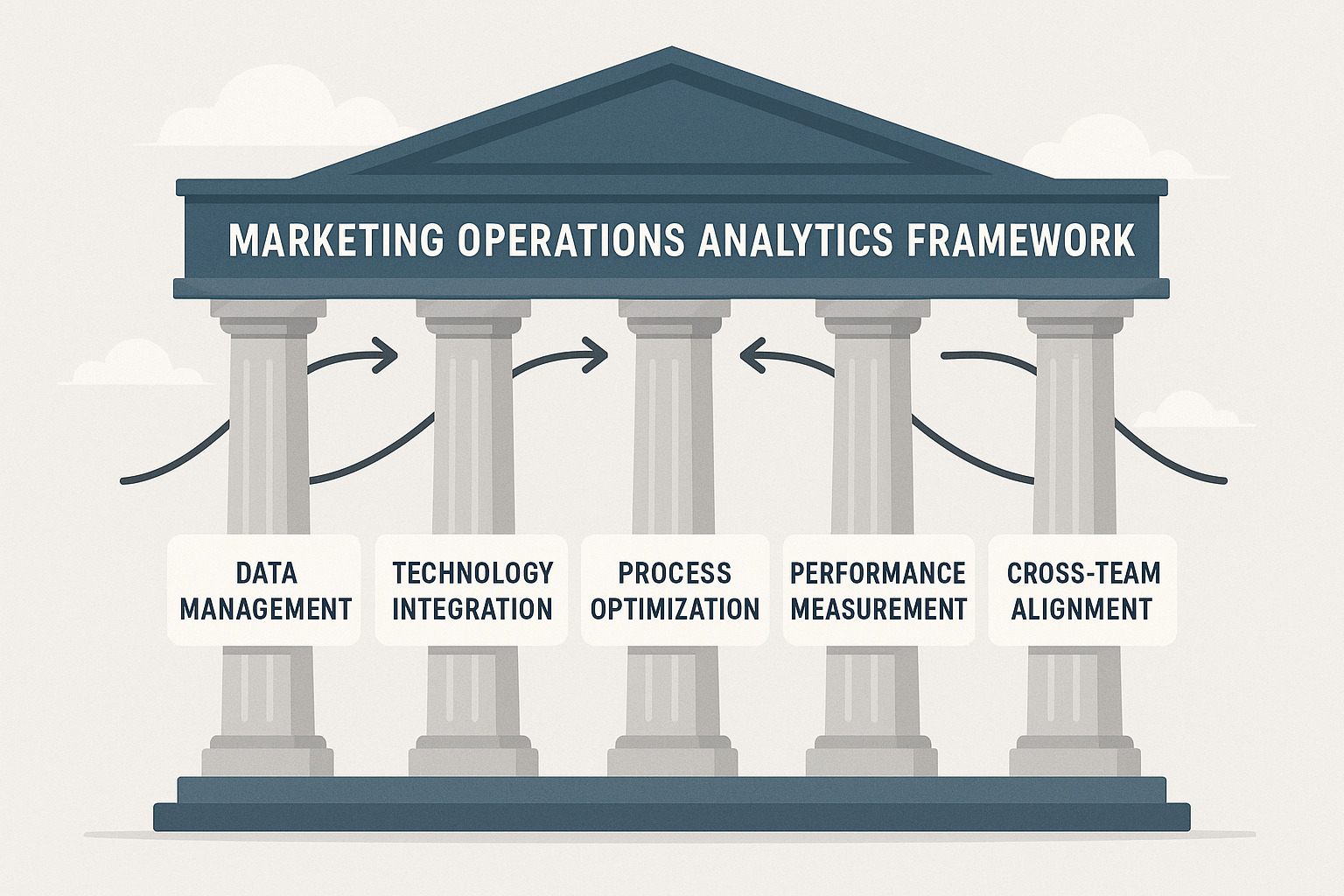
Building a successful marketing operations analytics function isn’t about throwing technology at the problem and hoping for the best. It’s about creating a solid foundation that can grow with your business and deliver results.
Think of it like building a house. You wouldn’t start with the fancy finishes before laying a proper foundation, right? The same principle applies here. Every high-performing marketing operations analytics function requires five essential pillars working in tandem.
Data management forms the bedrock. Without clean, reliable data, everything else falls apart. Technology integration ensures that your tools communicate with each other, rather than creating more silos. Process optimization eliminates the bottlenecks that slow down your team and frustrate everyone involved. Performance measurement provides the insights that truly matter to your business. And cross-team alignment makes sure everyone is rowing in the same direction.
These pillars don’t work in isolation. They support each other, creating what we call operational excellence—the ability to consistently deliver marketing results that make your CFO smile when they see the revenue numbers.
For a deeper dive into the technology side of things, our guide on Marketing Operations Technology covers everything you need to know about building a tech stack that works.
Here’s the uncomfortable truth: Data quality is what separates marketing teams that drive real business results from those that create pretty reports nobody acts on. After all, poor data quality isn’t just annoying; it can also be detrimental. It’s expensive and can completely derail your marketing operations analytics efforts.
The foundation of effective data management starts with governance. This means establishing clear rules about who owns what data, how it is named, and how often it is updated. Without these basics, you’ll spend more time fixing data problems than analyzing insights.
A Customer Data Platform (CDP) becomes essential as your business grows. It centralizes all your customer information from different touchpoints, creating unified profiles that make sense. Besides having all your data centralized in one place, you will also have accurate, real-time information that helps you make better decisions.
ETL processes—extracting, transforming, and loading data—require automation and close monitoringtr. Manual data transfers are prone to errors and time-consuming. Set up automated workflows that validate data accuracy before it enters your systems, and continuously monitor the health of these data pipelines to ensure accuracy.
The metrics that matter most for data quality are completeness (how many required fields are filled), accuracy (whether the data matches reality), consistency (the same formats are used across all systems), and timeliness (how current is the information). Track these regularly, because data quality problems compound quickly if left unchecked.
Choosing the right KPIs for your marketing operations analytics can make or break your entire program. When you use the wrong metrics, you can fall down expensive rabbit holes that don’t impact your business. Instead, ensure you have the right ones in place to turn data into actionable insights that drive growth.
Pipeline velocity metrics help you understand how efficiently your marketing engine converts prospects into customers. When you track the time from lead creation to sales qualified lead, average deal sizes by marketing source, and conversion rates between each stage of your funnel, you can find insights that show you where to focus your optimization efforts.
Cost and efficiency metrics keep you honest about ROI. After all, the cost per acquisition by channel tells you where your marketing dollars work the hardest. The ratio of marketing-qualified leads to sales-qualified leads indicates how effectively you’re targeting the right prospects. The customer lifetime value to customer acquisition cost ratio reveals whether your marketing investments are sustainable in the long term.
Attribution models become particularly challenging in B2B due to the long and complex sales cycles. First-touch attribution is well-suited for measuring awareness campaigns, while multi-touch attribution provides a more comprehensive view of the whole customer journey. Time-decay attribution gives more credit to recent interactions, which makes sense for lengthy sales processes.
The key is matching your KPIs to your business stage and objectives. Early-stage companies might focus heavily on lead generation metrics, while established businesses need to emphasize revenue attribution and customer retention. Don’t try to track everything. Instead, focus on the metrics that directly influence the decisions you need to make.
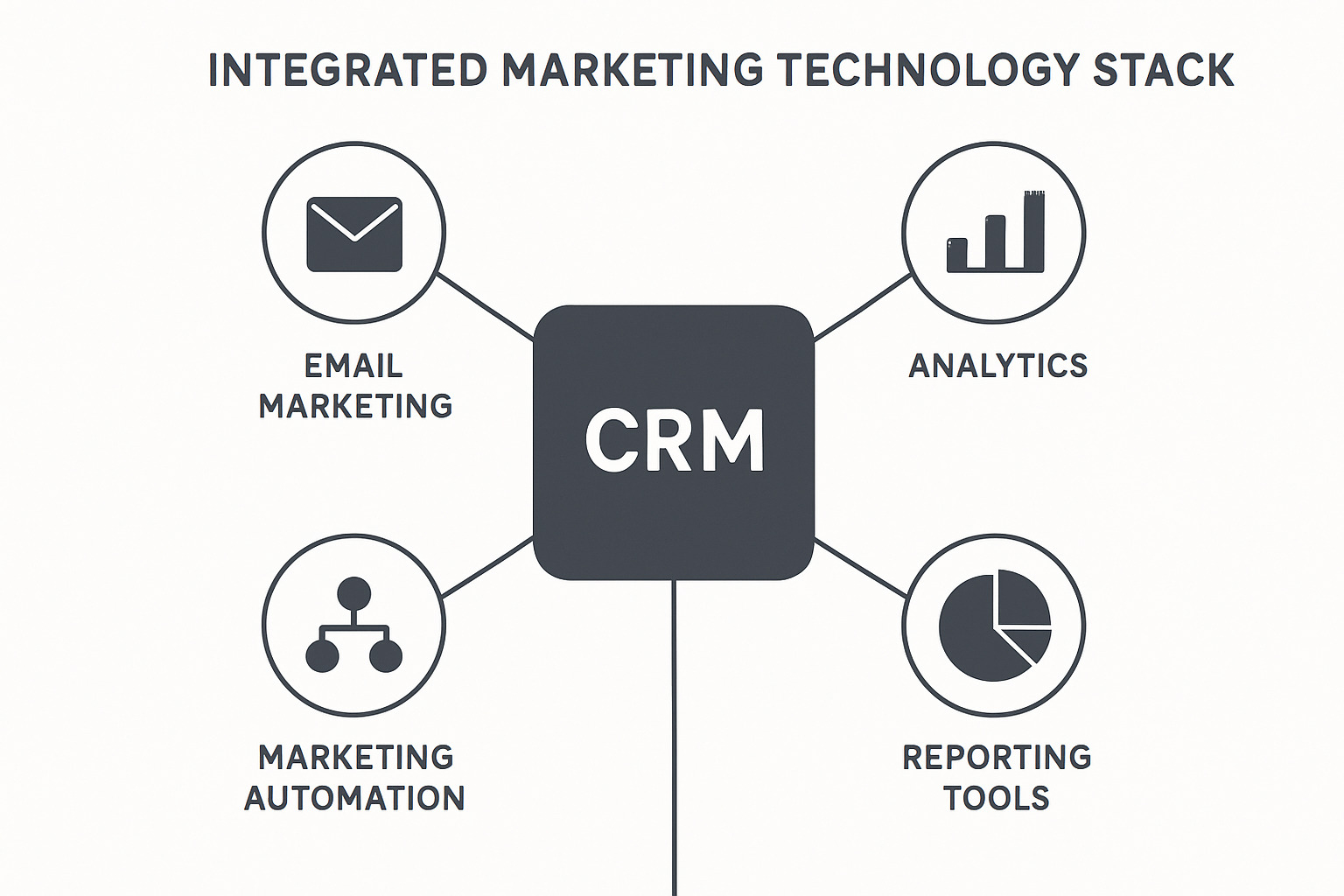
Building the right tech stack for marketing operations analytics feels like solving a puzzle where half the pieces keep changing shape. Many marketing operations leaders report challenges with adopting software tools across their organizations.
The problem isn’t having too few tools. However, the bigger issue is having too many disconnected solutions that don’t talk to each other.
Most marketing teams start with good intentions, but they often find that these “best” tools create data silos, require manual workarounds, and leave gaps in their reporting.
The secret is to think of your tech stack as an integrated system, rather than a collection of individual tools. Your marketing operations analytics function depends on data flowing seamlessly between platforms, not getting stuck in digital traffic jams.
When choosing between an all-in-one platform versus best-of-breed tools, consider your team’s technical expertise and growth plans. All-in-one platforms offer lower integration complexity and higher data consistency, but they might limit your functionality in specific areas. Best-of-breed stacks provide excellent specialized capabilities but require more technical resources to maintain.
For most B2B companies, we recommend starting with an integrated platform approach and selectively adding specialized tools to address specific needs. You can learn more about this approach in our guide: Why an Integrated Tech Stack is Key.
Your Customer Relationship Management (CRM) system serves as the foundation of your marketing operations analytics. It needs to handle centralized lead and customer data, provide custom fields for marketing attribution, and offer automated lead scoring and routing. Most importantly, it must integrate smoothly with your other marketing tools.
Your Business Intelligence (BI) platform transforms raw data into actionable insights. Look for cross-platform data visualization, real-time dashboard capabilities, and automated report distribution. The best BI tools make complex data feel simple and help you spot trends before they become apparent.
A solid Data Management Platform (DMP) handles the heavy lifting of data processing. It should offer audience segmentation capabilities, third-party data integration, and features that ensure privacy compliance. Don’t overlook real-time data processing since delayed insights often become useless insights.
Your marketing automation and workflow tools execute the strategies revealed by your analytics. They need campaign execution and management, lead nurturing automation, and A/B testing capabilities. The key is finding tools that provide detailed performance tracking without overwhelming your team with unnecessary complexity.
A well-maintained tech stack is like a well-maintained car – it runs smoothly, lasts longer, and doesn’t break down at the worst possible moment.
Documentation becomes your best friend as your stack grows. Maintain up-to-date system architecture diagrams and document all custom integrations and workflows. Create user guides for each platform and track tool usage and ROI metrics.
Training and adoption determine whether your tech stack becomes a productivity multiplier or an expensive digital paperweight. Develop role-specific training programs and create certification requirements for tool usage. If people aren’t using the tools, the tools aren’t working.
Privacy and compliance can’t be afterthoughts in today’s regulatory environment. Implement GDPR and CCPA compliance measures, conduct regular security audits of vendors, and maintain data processing agreements with all vendors.
Vendor management keeps your stack healthy and cost-effective. Schedule regular contract reviews and negotiations, monitor performance against SLAs, and maintain backup vendor relationships.
The goal isn’t to have the most sophisticated tech stack in your industry. It’s about having the right tools working together seamlessly to support your marketing operations and analytics goals.

Here’s where the rubber meets the road. You’ve built your data foundation, integrated your tech stack, and created beautiful dashboards. But none of that matters if you can’t turn those insights into actual revenue.
Marketing operations analytics transforms from a nice-to-have into a must-have when it starts driving real business outcomes. The companies that get this right see remarkable results – teams with aligned sales and marketing are significantly more effective at closing deals, according to information on sales-marketing alignment from Adobe.
But here’s the thing – alignment doesn’t happen by accident. It requires the proper operational framework and shared metrics that everyone cares about.
The most successful B2B companies utilize closed-loop reporting to track every lead from initial contact to the close of a deal. This means you can finally answer the question that keeps executives up at night: “What’s marketing’s real contribution to revenue?”
Predictive modeling takes this a step further. Instead of just reporting what happened last month, you can forecast pipeline based on current marketing activities. Imagine walking into a budget meeting knowing exactly how much pipeline your campaigns will generate – and having the data to back it up.
Sales alignment metrics create the shared language that marketing and sales teams desperately need. When both teams track lead quality scores, sales accepted lead rates, and time from MQL to SQL conversion, finger-pointing stops and collaboration begins.
For a comprehensive approach to connecting marketing and sales through data, check out our The Definitive Guide to RevOps.
Smart campaign planning starts with understanding what worked in the past. Data-driven audience segmentation goes beyond basic demographics to identify behavioral patterns that predict conversion. You’ll find that your highest-value prospects might not be who you think they are.
Strategic A/B testing moves beyond tweaking subject lines to testing fundamental operational improvements. What if you tested different lead scoring models? Or compared nurture workflow effectiveness? These operational tests often deliver bigger wins than creative changes.
Budget allocation optimization becomes a scientific rather than a political process. When you can calculate ROI by channel and campaign type, identify diminishing returns thresholds, and model budget scenarios, those budget meetings become a lot more productive.
The best marketing operations teams borrow a page from software development with agile retrospectives. After each campaign, they ask three simple questions: What worked? What didn’t? Why?
This isn’t about blame – it’s about learning. Document the lessons, implement changes in the next campaign cycle, and watch your performance steadily improve.
Benchmarking and performance standards help you stay honest about your progress. Compare your metrics against industry benchmarks, set realistic but challenging targets, and track improvement trends over time.
Forecasting and planning transforms from guesswork into science. Use historical data to predict future performance, model various scenarios for budget planning, and identify seasonal trends that inform resource allocation.
Let’s be honest – marketing operations analytics can feel overwhelming at first. We get questions about this all the time, and they usually boil down to three main concerns: “Do we have the right people?” “What should we measure?” and “How do we start without breaking the bank?”
Building a strong marketing operations analytics team is like assembling a puzzle. You need pieces that fit together, but they don’t all have to come from the same person.
The technical foundation starts with data analysis skills. Someone on your team needs to be comfortable with SQL, Excel, or Google Sheets, as well as fundamental statistical analysis. They should also understand marketing technology – CRM administration, marketing automation platforms, and how to set up API integrations.
Analytics tools expertise is crucial too. This means knowing your way around Google Analytics, business intelligence platforms, and attribution modeling. Don’t forget project management skills – Agile methodologies and workflow optimization keep everything running smoothly.
However, what many companies overlook is that strategic skills are just as critical as technical ones. Your team needs solid business acumen to understand sales processes, revenue models, and how marketing fits into the bigger picture. They require cross-functional communication skills to effectively convey technical insights to executives.
Process design and stakeholder management round out the strategic skill set. Someone needs to optimize workflows and manage change, while balancing needs across marketing, sales, and leadership teams.
The soft skills often make the difference between good and great. Problem-solving abilities help identify root causes instead of just symptoms. Attention to detail ensures data accuracy. Adaptability keeps you current with rapidly changing technology.
Executives care about metrics that directly connect to business outcomes. They want to know if marketing is generating revenue, not just activity.
Revenue-focused metrics always get attention. Marketing-influenced revenue shows the total revenue from deals where marketing played a role. Customer acquisition cost (CAC) reveals how much you spend to acquire new customers. Return on marketing investment (ROMI) demonstrates revenue generated per marketing dollar spent.
Operational efficiency metrics matter because they indicate how effectively your marketing engine operates. Pipeline velocity measures the speed at which leads progress through the funnel. Lead quality scores track the percentage of marketing leads that become customers. The sales cycle length represents the time from the first touch to the closed deal.
Strategic alignment metrics demonstrate marketing’s contribution to broader business goals. Market share growth shows percentage of target market captured—brand awareness metrics track unaided brand recognition in target segments. Customer retention rates indicate how effectively you’re retaining existing customers.
The key is choosing metrics that align with your company’s current priorities and growth stage. A startup might focus on lead generation and cost efficiency, while an established company emphasizes customer lifetime value and market share.
Starting with marketing operations analytics doesn’t require a massive budget – it requires an innovative approach and realistic expectations.
Phase 1 should focus on building the foundation during your first three months. Audit your current data and identify quality issues. Standardize naming conventions across all platforms. Implement basic reporting dashboards to document current processes and workflows.
Phase 2 delivers quick wins in months four through six—Automate manual reporting tasks. Implement lead scoring based on historical data. Create attribution reports linking marketing activities to revenue. Establish regular review cycles with sales teams.
Phase 3 introduces advanced analytics in months seven through twelve. Implement predictive modeling for lead scoring. Build comprehensive attribution models. Create forecasting models for budget planning.
Budget-friendly tools can get you surprisingly far. Google Analytics provides free web analytics and goal tracking. HubSpot CRM offers free CRM functionality with basic marketing features. Google Data Studio handles free data visualization and reporting. Zapier enables affordable automation between platforms.
Resource optimization often matters more than tool selection. Start with existing team members and provide training rather than hiring immediately. Use free online resources and certifications to build skills. Partner with agencies for specialized expertise you can’t develop internally.
The biggest mistake is trying to do everything at once. Pick one area, do it well, show results, then expand.
Building a successful marketing operations analytics function is like assembling a puzzle – every piece needs to fit perfectly to see the complete picture. But here’s the thing: once you get it right, the change is remarkable.
The companies that accept marketing operations analytics don’t just collect more data – they make smarter decisions. They stop guessing which campaigns work and start knowing. They move from defending their marketing budget to asking for more because they can prove exactly what they’re delivering.
The path forward starts with accepting a straightforward truth: your marketing operations are either helping you grow or holding you back. There’s no middle ground in today’s competitive B2B landscape.
Focus on building your foundation first – clean data and integrated systems may not be glamorous, but they’re essential. Then choose KPIs that matter to your business, not just metrics that look good in reports. Design everything to scale because what works for your current team size might break when you double your marketing efforts.
Most importantly, accept the continuous improvement mindset. The best marketing operations teams we work with never stop optimizing their processes. They utilize data to continually evolve and improve, turning every campaign into a learning opportunity.
Alignment is everything. When marketing, sales, and customer success teams share the same metrics and goals, magic happens. Leads get better, deals close faster, and everyone wins.
At The B2B Mix, we’ve seen this change happen. Companies come to us with disconnected tools, messy data, and frustrated teams. They leave with streamlined operations, clear insights, and marketing that drives revenue growth.
The beauty of marketing operations analytics is that it’s not about having the most significant budget or the most sophisticated tools. It’s about being systematic, strategic, and focused on what truly matters to your business.
Ready to stop playing marketing roulette and start building a revenue-generating machine? Our Marketing Operations Consulting services help you cut through the complexity and make something that works—no jargon, no fluff – just real results.
The question isn’t whether you need marketing operations analytics; the question is whether you need them. The question is how much longer you can afford to operate without it.