
Many marketing teams struggle with bloated MarTech stacks. This post shows how to audit, streamline, and consolidate tools without losing functionality. Learn how AI is transforming MarTech, filling gaps, and automating tasks, helping marketers build a simpler, smarter stack that delivers more impact in 2026.
By Lisa Heay, Vice President of Business Operations at Heinz Marketing
I recall a time in my career when looking for that magic tool to solve every little problem was the norm. The MarTech landscape had exponentially exploded and there were so many cool things to try!
But If you’ve been following marketing tech trends lately, you’ve probably noticed one big shift in 2026: MarTech stacks are consolidating. Companies are moving away from a sprawling collection of niche tools and toward fewer, more capable platforms, often with AI baked in.
But if the thought of cutting tools makes you nervous and you’re up in the middle of the night asking yourself questions like “what if we lose functionality?” you’re not alone. Simplifying your stack doesn’t have to mean sacrificing capability. It can actually make your team more efficient and your marketing smarter.
Here’s a practical guide to auditing, streamlining, and optimizing your MarTech stack without losing the features you rely on.
Before you can simplify, you need a clear picture of what you have. Start by creating a comprehensive list of every tool your marketing team uses, even the ones people just log into occasionally.
In your list, you’ll want to include the following:
Be honest…some tools are probably underused, while others overlap functionality with multiple platforms. This is also where AI can be a game-changer. For example, AI-driven analytics or content tools might replicate the function of two or three older systems, freeing up both budget and mental bandwidth.
Once your audit is complete, look for overlap. Are you running two email platforms, two analytics dashboards, or multiple tools that handle social scheduling? Redundant tools add cost and complexity, often with minimal additional benefit.
Next, identify gaps that could emerge if you retire a tool. For instance, if you consolidate your email and automation platforms, do you lose personalization options?
If so, there could be an opportunity for AI to help bridge those gaps. AI can handle tasks like predictive scoring, content recommendations, and automated reporting. Functions that previously required multiple specialized tools.
A quick tip: not every duplication is bad. Sometimes redundancy is a safety net. But if a tool isn’t adding clear value, is putting a strain on your budget, or isn’t widely adopted, it could be a candidate for retirement.
Now comes the hard, but exciting, part: making decisions. I like to think in three categories:
A simple table can help visualize your decisions. Something like this:
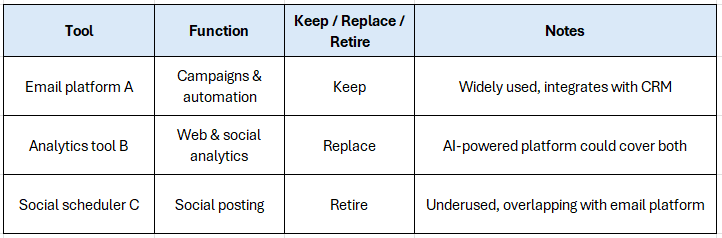
When deciding, consider not just current functionality but future potential. AI capabilities are becoming table stakes. Platforms with AI features can reduce the need for smaller, more niche solutions.
Once decisions are made, it’s time to execute, and a structured plan is key.
AI can make this phase easier. For example, some platforms can automatically clean and migrate data, flag duplicates, or even generate reports to ensure nothing gets lost in the transition.
One thing to avoid: trying to rip everything out at once. Staggered migration reduces risk, gives the team time to adapt, and ensures campaigns keep running smoothly.
Consolidation is not a one-and-done exercise. Once your new stack is live, define KPIs to track success:
AI can help here, too. Platforms with predictive analytics or automated dashboards can show where consolidation is paying off, or where adjustments are needed. Make reviewing your stack a regular habit, ideally every 6–12 months. MarTech evolves quickly, and what works today might be redundant tomorrow.
One thing that’s different about 2026 is how AI is embedded across MarTech platforms. It’s no longer just a nice-to-have. AI can replace multiple tools, automate repetitive tasks, and surface insights faster than any manual process.
For example:
By leveraging AI, companies can consolidate more confidently. Fewer tools don’t have to mean less functionality. In fact, when used correctly, AI often expands what your stack can do, letting your team focus on strategy and creativity rather than manual work.
Simplifying your MarTech stack doesn’t mean losing functionality. By auditing your tools, identifying redundancies, making strategic decisions, and planning carefully, you can build a leaner, more efficient stack that actually empowers your team.
AI plays a key role in this evolution. It allows you to consolidate without compromise, automates repetitive tasks, provides deeper insights, and even enhances personalization and campaign performance. In other words, fewer tools combined with smarter AI capabilities can give you more impact, not less.
If your team is feeling buried under too many tools, now is the perfect time to start your audit. With a simplified, AI-enhanced MarTech stack, 2026 could be your most productive marketing year yet.
Want to chat? Email us for a free brainstorm session!
Fonte: Link original