
Learning how to automate marketing is simpler than you think, but the impact can be game-changing for your business. Here’s the quick answer:
The 6-Step Marketing Automation Process:
If you’re drowning in repetitive tasks like manual email sends, social media posting, or lead follow-ups, you’re not alone. The good news is that automation can be a valuable aid. But here’s the thing most guides won’t tell you: marketing automation isn’t about replacing human creativity. It’s about freeing up your time so you can focus on strategy, relationship-building, and the high-impact work that drives results.
The beauty of modern marketing automation is that you don’t need a massive budget or technical team to get started. You need a clear plan and the right approach.

Common How to automate marketing vocab:
Let’s start with the basics. Marketing automation is essentially your digital assistant that never calls in sick. It utilizes software to automate repetitive marketing tasks that consume your day – tasks such as sending follow-up emails, posting on social media, or updating customer records. The magic happens when it delivers the right message to the right person at exactly the right moment.
But here’s where it gets interesting. This isn’t just about making your life easier (though it definitely does that). Learning how to automate marketing has become a critical skill because it directly impacts your bottom line. Companies using marketing automation see significant productivity boosts – we’re talking about freeing up hours every week that you can spend on strategy instead of manual tasks.
The personalization angle is huge, too. Today’s customers expect experiences custom-made for them, and getting this right can make or break your business relationships. Scientific research on personalization reveals the significant impact it has on business outcomes – both positively when executed effectively and negatively when it falls short.
The numbers don’t lie either. Marketing automation adoption is skyrocketing across industries, and there’s a good reason why. This Statista study on marketing automation adoption reveals how businesses are integrating automation across multiple channels to stay competitive.
The business case for automation isn’t complicated – it comes down to three game-changing benefits that every B2B team can appreciate.
Time savings top the list for obvious reasons. Instead of manually sending dozens of follow-up emails or spending hours scheduling social posts, your team can focus on the work that actually requires human creativity and strategic thinking. We’re talking about reclaiming significant chunks of your week that were previously lost to repetitive tasks.
Revenue growth naturally follows from improved efficiency. When your leads get immediate, personalized follow-ups and your customers receive relevant offers at just the right moment, conversion rates improve. Marketing automation ensures no lead falls through the cracks and every touchpoint adds value to the customer relationship.
Better alignment between marketing and sales teams might be the most underrated benefit. When everyone has access to the same customer data and automated lead scoring, sales knows exactly which prospects are ready for a conversation. No more cold handoffs or missed opportunities.
Let’s tackle the elephant in the room – the misconceptions that keep teams from embracing automation.
The spam fear is probably the biggest myth we encounter. People worry that automation means sending generic, robotic messages that annoy customers. The reality? Good marketing automation is all about hyper-personalization at scale. It uses customer data to send more relevant, timely messages than you could ever manage manually.
Then there’s the “set-and-forget” illusion. Yes, automation runs workflows without your constant attention, but it’s not a magic solution you can ignore. Think of it like tending a garden – you plant the seeds (set up workflows), but you still need to water, prune, and adjust based on what’s growing well.
Finally, the cost barrier myth stops many small teams before they even start exploring options. While enterprise solutions can be expensive, there are plenty of scalable options that deliver strong ROI from day one. The key is starting with what you need now and growing your automation as your business grows.
Ready to ditch the drudgery and accept efficiency? We thought so! Here’s our super practical, six-step blueprint for successfully implementing marketing automation. Think of it as your roadmap to a less stressful, more productive marketing life.
A good rule of thumb: if you’re doing something over and over, it’s a prime candidate for automation. If you’re manually sending that same follow-up email again and again, it’s time to set it free!
This blueprint covers everything from defining your goals to launching and refining your automated processes.
Before you even think about software, pause and ask yourself: “Why are we doing this?” What specific headaches are you trying to cure? Are you aiming to bring in more leads, spend less time on repetitive tasks, keep your customers happier, or boost the return on your marketing efforts?
Understanding your objectives and setting clear Key Performance Indicators (KPIs) is absolutely essential. This “strategic fit” ensures your automation efforts are purposeful, deliver real benefits, and aren’t just automation for the sake of automation. It’s about working smarter, not just harder.
Next, let’s play detective and trace your customer’s journey. From the moment they first hear about your brand to the point they become a loyal advocate, what are those key moments of interaction? Where do they bump into your marketing, sales, and support teams?
Mapping this journey helps you spot those repetitive tasks or crucial moments where automation can truly improve their experience. Imagine automated welcome sequences for new sign-ups, helpful follow-ups after a demo, or personalized emails triggered by a specific content download. Consider the entire customer lifecycle and how automating marketing can create smooth, consistent experiences across all channels.
Let’s be honest, introducing automation can sometimes make teams a little nervous. It’s easy for people to worry it might threaten their job. But here’s the trick: frame automation as a helpful superhero for everyone.
Highlight how it frees up valuable time, eliminates boring and repetitive tasks, and allows your team members to focus on the fun, creative, and strategic work that genuinely makes an impact. Show how it boosts efficiency and improves results, ultimately making everyone’s job easier and more rewarding. Strong cross-team collaboration is your secret weapon here for smooth sailing and successful adoption.
The market is abuzz with marketing automation software, ranging from comprehensive platforms to highly specialized tools. Your pick should perfectly match your specific business needs, budget, and what you’re already using.
Consider important factors like the features it offers, how much it can grow with you (scalability), how easy it is to use, the quality of its customer support, and, crucially, its integration capabilities with your existing systems. Don’t get distracted by every shiny new gadget; focus on what truly fits your “why” from Step 1 and can scale with your business. The right platform should streamline your operations and provide you with valuable insights for understanding your customers and segmenting them effectively.
Here’s the truth: automation flows are only as powerful as the data feeding them. Accurate, real-time customer data isn’t just nice to have; it’s essential for truly effective personalization and segmentation.
Consider centralizing your customer data in a Customer Data Platform (CDP) or ensuring that your CRM is well-maintained. High-quality data empowers you to build detailed customer profiles, create targeted audience segments, and trigger automation based on precise user behavior. Additionally, it’s essential for adhering to data privacy rules and best practices – keeping you compliant and your customers satisfied. This is truly how to automate marketing that delivers real results.
Don’t chase perfection from day one. Instead, start small! Automate one or two key processes that cause you the most pain, and then build from there. Once your automation workflows are live, keep a close eye on their performance.
Run A/B tests on things like email subject lines, call-to-action buttons, or different content variations. Analyze the results, gather feedback, and then tweak and improve. This continuous improvement loop ensures your automation strategies stay sharp, effective, and continually adapt to changing customer behaviors and market trends.
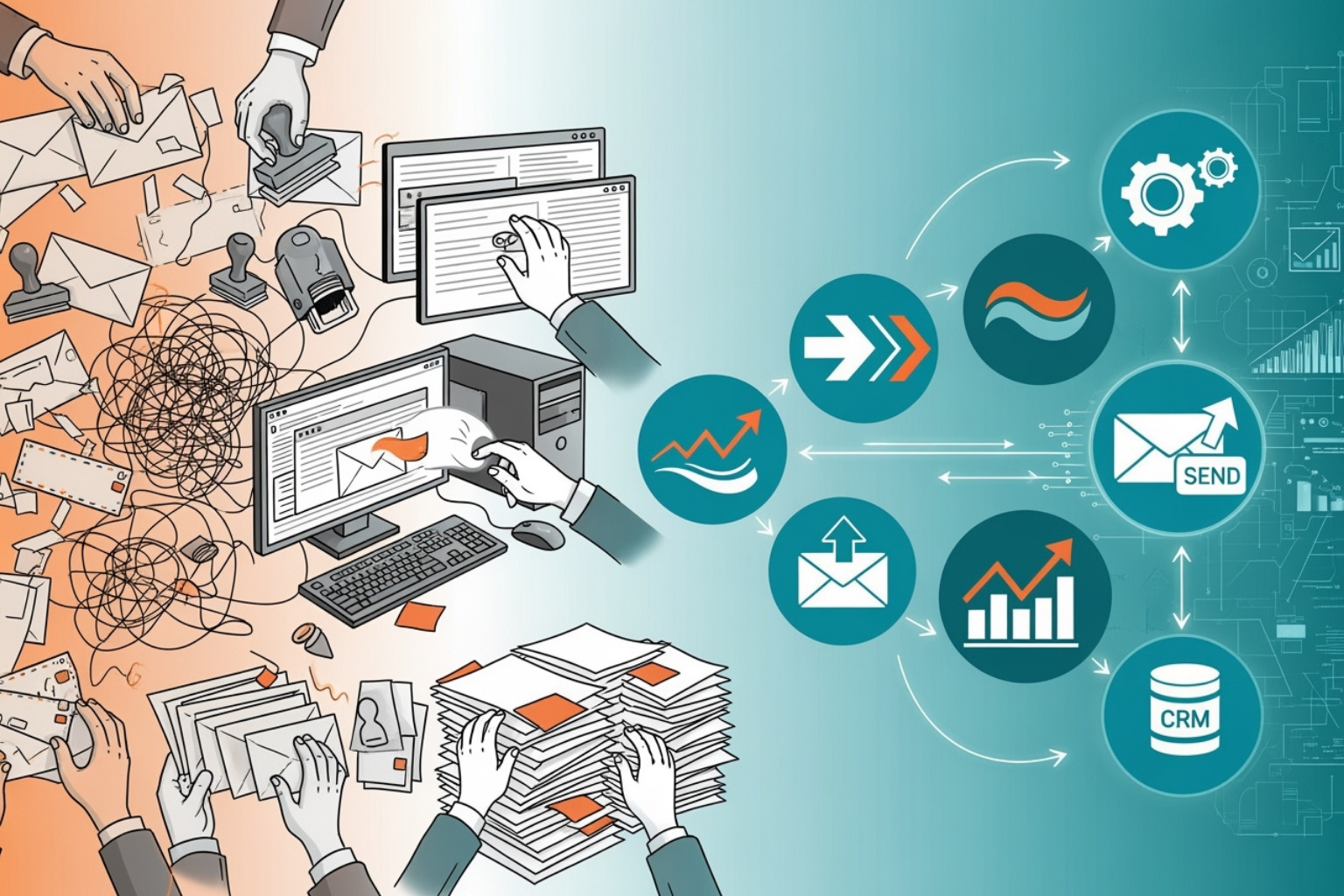
Marketing automation can apply to various aspects of your operations. Let’s look at some of the most impactful areas:
For more insights into optimizing your marketing operations, check out our article on Marketing Campaign Operations.
Email marketing is arguably the most popular method for automating processes. This includes:
Maintaining an active presence across multiple social networks can be a full-time job. Automation helps with:
Make your ad spend work harder:
Streamline your sales pipeline:
Gain insights without the manual grind:
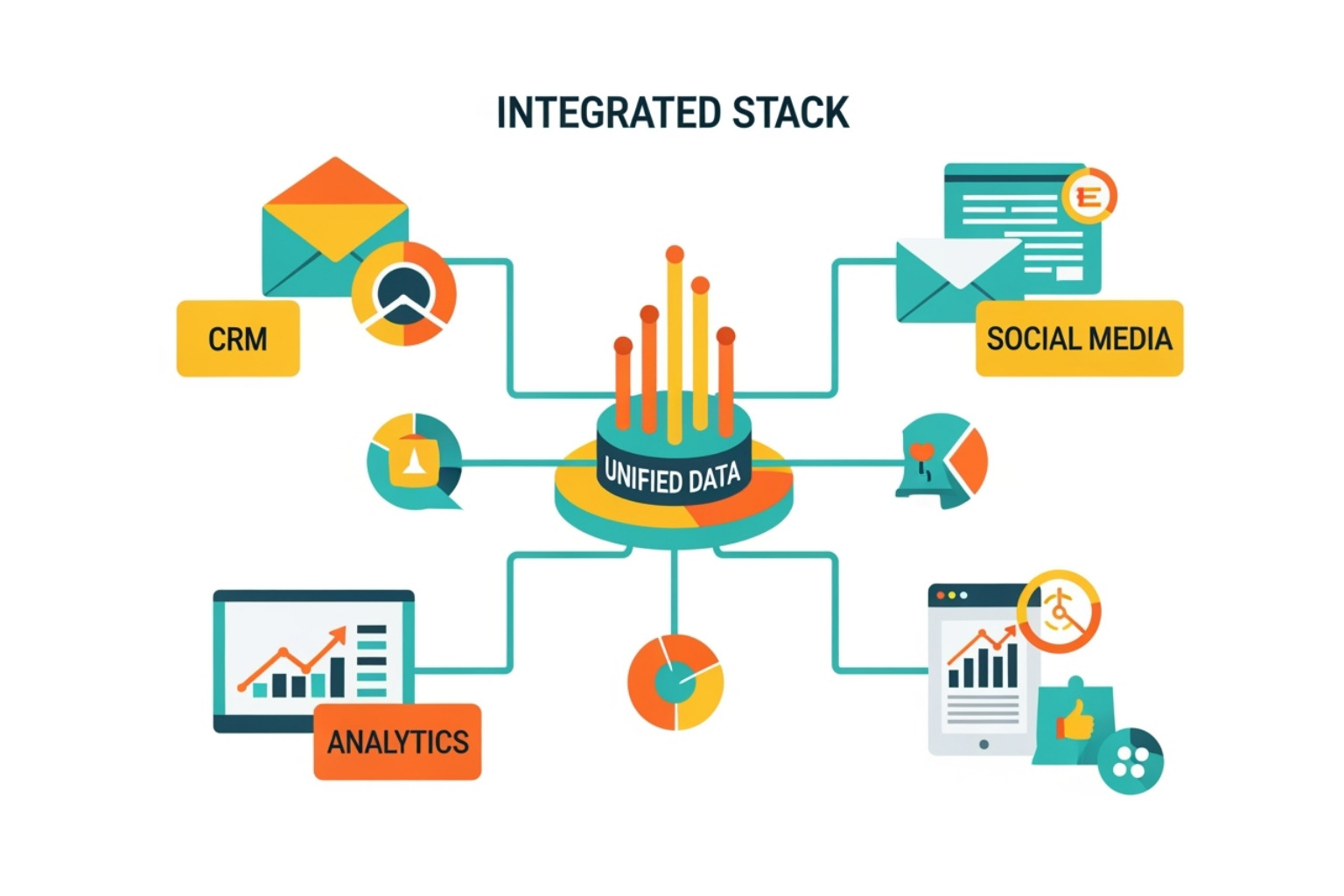
Alright, you’ve got your blueprint for how to automate marketing, and you know which processes you want to tackle. Now comes the exciting part (and sometimes, the slightly overwhelming part!): choosing the right tools and making them all play nicely together. Think of your tech stack as the engine of your marketing automation machine. For it to hum efficiently, all the parts need to be connected and working in sync. An integrated tech stack isn’t just a nice-to-have; it’s truly key to your B2B success, ensuring that all your valuable data flows smoothly between systems. Want to dive deeper into why this matters? Check out More info about an Integrated Tech Stack.
As you start exploring the vast world of marketing software, you’ll notice a few main types. There are fantastic all-in-one platforms that offer a comprehensive suite of features – think email, social media, CRM, and analytics all under one roof. These can be great for a unified experience. Then, you have your specialized tools. Perhaps you require a robust platform solely for your email marketing, or a dedicated solution for social media scheduling and monitoring. These “best-of-breed” tools can excel in their specific niche. And let’s not forget the increasingly popular AI-assisted tools! Many modern platforms are now incorporating artificial intelligence to assist with tasks ranging from optimizing content and predicting customer behavior to drafting ad copy. It’s like having an extra brain helping your automation efforts shine!
Before you commit to any platform, it’s like going on a first date – you need to ask the right questions! Here’s a little checklist to guide your decision-making:
This is where the magic truly happens! The real power of marketing automation isn’t just in the individual tools, but in how they communicate. Imagine your CRM, website, email platform, and analytics tools all chatting away, sharing insights and data. This seamless communication ensures you have a single source of truth for all your customer information, empowering your automation to be truly intelligent.
So, how do you get them to open up and talk? Often, platforms come with handy native connectors, which are built-in integrations with popular tools – think of them as ready-made translation guides. For more unique connections or custom needs, APIs (Application Programming Interfaces) are your best friends. They allow different software applications to exchange data directly. And sometimes, you may need a go-between, a type of digital interpreter known as middleware. These integration platforms can act as a bridge between disparate systems, consolidating all your data. This data centralization is precisely what allows you to build those rich, real-time customer profiles and truly boost your efforts to automate marketing. It ensures that every piece of your tech stack works together to deliver personalized, effective experiences.
Once your marketing automation is up and running, you might feel like you’ve conquered the world! But here’s a little secret: that’s just the beginning of the trip. True success with automating marketing isn’t just about setting things up; it’s about constantly monitoring, tweaking, and evolving. To truly see the magic happen and prove your return on investment (ROI), you need to become familiar with your data. This means not just tracking results, but also understanding attribution – figuring out which parts of your automated journey are truly driving results – and getting savvy with ROI modeling to predict future gains.
For a deeper dive into the technologies that power these efforts, explore More info about Marketing Operations Technology. You’ll want a clear view of your progress, much like a well-designed dashboard.
When it comes to measuring success, let’s look beyond just email open rates (though those are important!). We want to see the big picture – the metrics that truly impact your bottom line. Think about your revenue per lead: how much moolah is each automated lead bringing in? Is your Customer Acquisition Cost (CAC) decreasing? That’s the sweet spot!
Don’t forget to track engagement scores, which indicate whether your automated messages are truly resonating with your audience. Are they clicking, sharing, and interacting? And, by the way, let’s not overlook productivity metrics. How much time are you saving? How many tasks are now happening on autopilot? Quantifying these efficiency gains is key to showing the internal value of your automation efforts.
‘Launch, learn, refine’ step in our blueprint? This is where that loop truly comes to life. Automation isn’t static; it’s a living, breathing system that needs your attention.
Think of it like being a marketing scientist (minus the lab coat, unless you’re into that!). You’ll want to test constantly. Try different email subject lines, tweak your call-to-action buttons, or even adjust your audience segments. Then, analyze the results. What worked? What fell flat? Dive into the data to spot those bottlenecks or exciting new opportunities. Finally, iterate. Use what you’ve learned to make smart, data-driven adjustments to your workflows, your content, and your targeting. It’s a never-ending cycle of improvement and growth!
Once you’ve got your core automation running smoothly and proving its worth, it’s time to dream bigger! Scaling up means expanding your reach and amplifying the impact of your efforts.
Consider expanding your automation to new channels. If email and social are humming, maybe it’s time for automated SMS marketing or integrating with live chat. If your business is global, consider internationalization – adapting your automated campaigns for different languages, cultures, and regions. For the truly future-focused, explore how advanced AI can enhance your efforts. AI can help with even deeper personalization, predictive analytics (enabling you to know what your customers will do next), and even generating content within your workflows. It’s like having a digital brain helping you make even more innovative marketing moves.

If you’re running a lean B2B team, you don’t need to break the bank or overwhelm yourself with complexity. Start with platforms that give you solid email automation, basic CRM features, and workflow capabilities without the enterprise price tag.
The key is focusing on the basics first. Look for tools that efficiently handle your most repetitive tasks, such as welcome sequences, lead nurturing, and basic segmentation. You want something your team can use without needing a computer science degree.
Most importantly, pick a platform that grows with you. What works for a 5-person team should still make sense when you’re 15 people. Affordability matters, but so does not having to migrate everything in six months because you outgrew your tools.
Here’s the honest answer: it depends on what you automate first, but quick wins are absolutely possible if you’re strategic about it.
Start with the low-hanging fruit. Automate your welcome email series or set up cart abandonment emails, and you could see results within the first 30 days. These are processes that either weren’t happening consistently before or were eating up hours of manual work.
Focus on 30-day metrics like email open rates, time saved on repetitive tasks, and any revenue recovered from automated follow-ups. For example, a well-executed welcome series can generate more qualified leads simply by ensuring every new subscriber gets consistent, timely information.
The bigger ROI comes over time as you layer in more sophisticated workflows. Still, those early wins help justify the investment and get your team excited about how to automate marketing more broadly.
Absolutely not. And waiting for perfect data is one of the biggest mistakes teams make. Progress beats perfection every single time.
Start with what you have. If your email addresses are clean and you can segment customers from prospects, you’re ready to begin. Yes, you’ll probably find some messy data along the way, but that’s helpful. Automation has a funny way of revealing exactly where your data gaps are.
Consider data cleansing as an ongoing process, rather than a one-time project. As you build workflows, you’ll naturally identify duplicate contacts, outdated information, or missing fields that are crucial for your automation goals. Address those issues as you find them, and your data quality will improve in tandem with your automation sophistication.
The worst thing you can do is spend six months “getting ready” while your competitors are already automating and seeing results. Start small, start messy, and clean up as you go.
So, you’ve journeyed with us through the ins and outs of automating marketing. It’s pretty clear by now, isn’t it? This isn’t just about getting some fancy new software. Nope! It’s a truly strategic shift that empowers your B2B marketing team to do more, achieve more, and make a bigger impact, all with greater efficiency.
Think of it as building a superstar team for your marketing efforts. By embracing automation, you’re creating a more responsive, personalized, and wonderfully scalable marketing operation. The best part? It frees up your precious time. No more drowning in repetitive tasks! Instead, you can focus on the truly creative and strategic work that makes your brand shine and builds lasting, genuine relationships with your customers. That’s where the magic happens!
Here at The B2B Mix®, we absolutely love helping B2B companies like yours. Our sweet spot is optimizing your marketing operations, streamlining complex processes, and executing digital strategies that deliver results. We take pride in being hands-on and jargon-free experts. What does that mean for you? Real results, delivered without the confusing tech-talk, and with genuinely responsive, human support. We’re all about making your life easier and your marketing stronger.
Ready to wave goodbye to manual headaches and hello to a marketing powerhouse? We’d love to chat! Please take the next step and connect with us to learn more about our HubSpot Services. Let’s work together to build an automation strategy that not only grows your business but also helps it truly thrive.