
Here’s what I’m covering this week: How to get the most out of personas in your day-to-day work across SEO, content, and the broader org.
Because in the AI-search era, personas built from organic queries and prompts have value for every touchpoint: ad copy, sales scripts, support docs, product messaging.
They carry the unfiltered language of your audience (their fears, hesitations, and demands) straight into the hands of the teams shaping your funnel.
If you’re not operationalizing search-data-based personas across departments, you’re missing one of the few forms of market intelligence that scale across SEO, marketing, sales, and product.
Personas shouldn’t live stagnantly in a slide deck. I’ll show you how to make them pull their weight across the org.
 Image Credit: Kevin Indig
Boost your skills with Growth Memo’s weekly expert insights. Subscribe for free!
Last week, I showed you how to create search personas based on data you already have available, along with how to use an LLM-ready persona card to extract custom insights.
But the best persona in the world doesn’t help if it collects dust in your Google Drive.
This week, I’m digging into how to make these search persona insights actionable – not only across your SEO processes and production, but also across broader teams that SEO work touches.
However, before we dive in, I want to share a few notable perspectives on search personas that came up in conversation on this LinkedIn thread:
Malte Landwehr, CPO & CMO at Peec AI, gave this visual example in the thread (with additional context) that resonated strongly. From his own research and testing, he shared a visual detailing LLM visibility for various headphones based on prompts for personas and use cases.
The findings? LLMs recommended different brands/products based on different persona-based prompts.
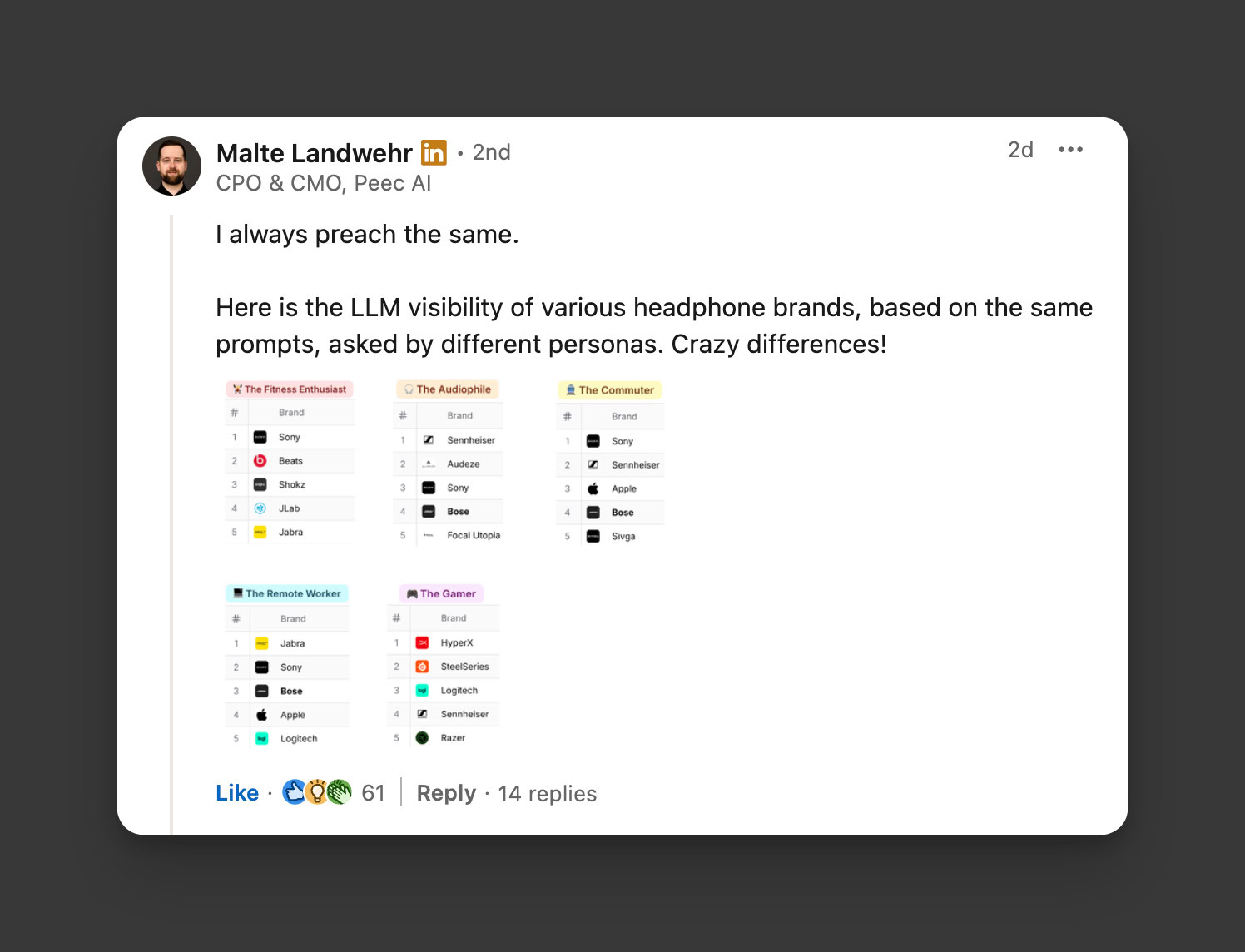 Image Credit: Kevin Indig
And below, David Melamed brings up an interesting and important question below.
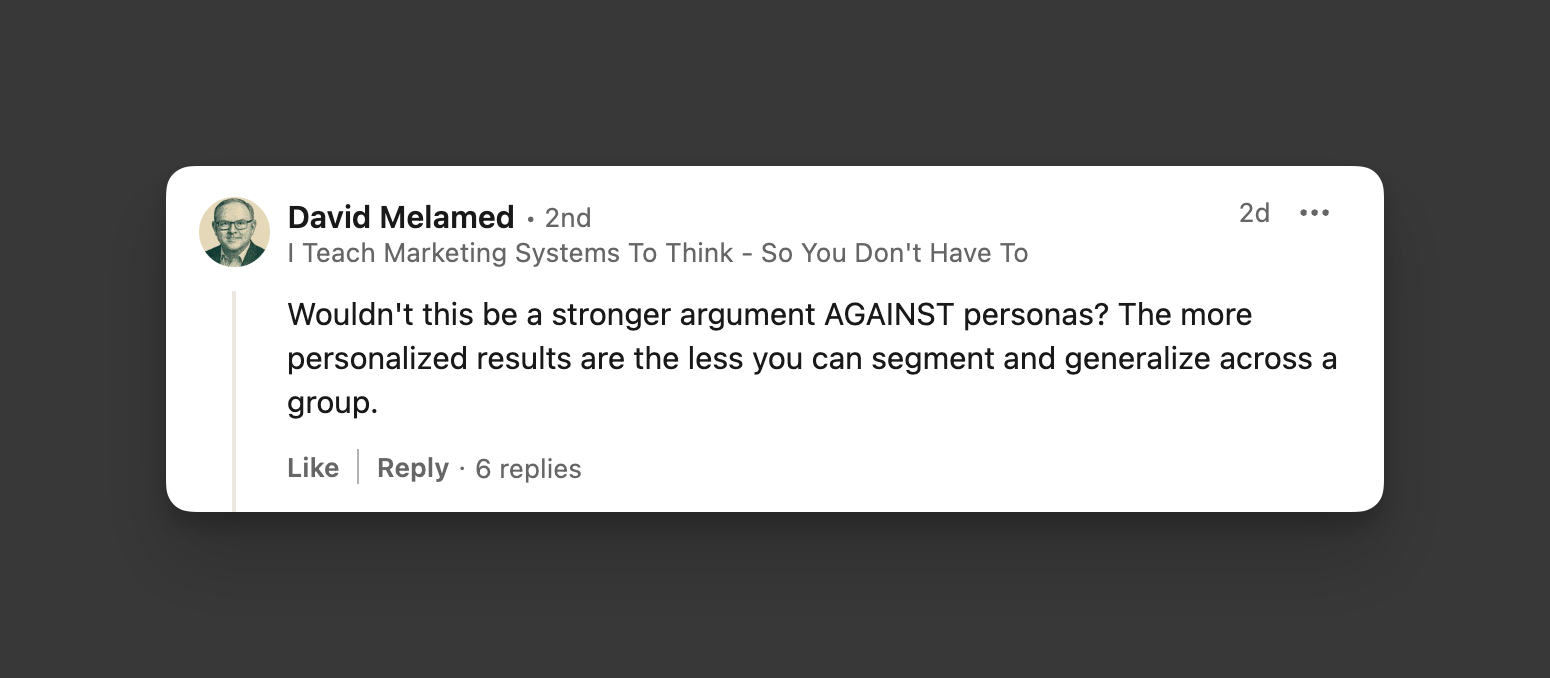 Image Credit: Kevin Indig
I agree with David: The more personalized search results are, the less you can segment or generalize across a group.
But if you check out our conversation in the comments, David absolutely gets it, and his concerns are valid.
He shares that “more long tail content and citations across more unique niches, scenarios and comparisons should beat out persona driven content” and that “looking at questions, related searches in search console, and Google and Microsoft ads search term reports… (along with) experience and other voice of customer research (listening to calls, analyzing reviews, reddit threads, complaints, etc..)” would be a helpful approach.
And that’s what I tackled last week in Personas are critical for AI search (part 1 on the persona topic): To succeed with user personas for SEO – and make them valuable and usable – the goal is to build custom, unique search personas from your actual in-house data and long-tail Google Search Console.
So, David brought up a valid point, one that’s aligned with how we should be building useful search personas for today.
Lastly, Elisa Daniela Montanari sums up how a lot of us feel about the shift toward qualitative research (along with mentioning her goals to upskill as an SEO by diving into user research tactics):
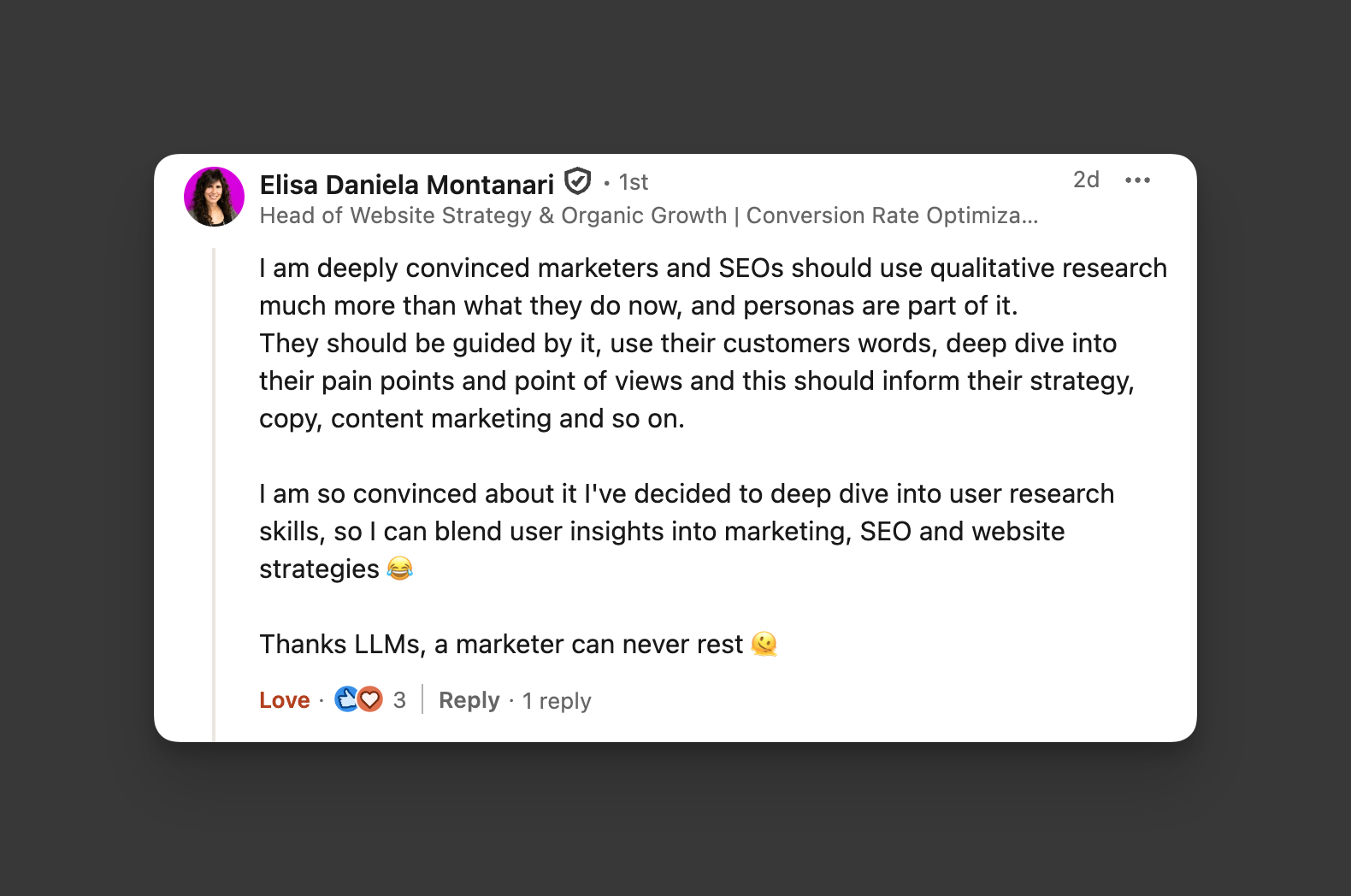 Image Credit: Kevin Indig
And with these conversations in mind…
I’d argue that high-quality, customer-centered SEO research captures unfiltered questions, painpoints, and intents at scale, across the entire journey – and that makes it one of the most versatile forms of market intelligence that you can use across your brand as a whole.
So if organic query and prompt research is so valuable and versatile, how do you ensure they’re actually used?
Because all strategists everywhere have had that stupidly challenging moment: After doing all the labor-intensive data-gathering of building user personas for SEO, it’s time to get your team or clients to use those insights regularly across SEO production.
You need to prep your findings so they’re not left gathering cobwebs in the dark corners of the cloud.
Not another slide deck or spreadsheet that gathers dust. A simple, easily-accessible hub that is a living, breathing document.
Translate data into the formats your team and stakeholders already use: dashboards, one-page briefs, funnel visualizations.
Think Notion, Airtable, Asana, Google Sheets, Slack Canvas – wherever your team is already working and discussing production.
Key contributors need to have access to fluidly comment and update as organic questions and pain points surface across your audience.
Position SEO research/persona use as a “horizontal competency” that makes every department smarter.
Kick off persona use with a short session showing:
A three-minute Loom video can do wonders.
Use the data you have (Google Search Console, Semrush, Ahrefs, LLM prompt monitoring tools) to back up the importance of use.
At the end of this memo, I have a slide deck template for premium subscribers that will help you build this narrative and guide effective persona implementation across teams.
Train your SEO/content contributors that personas don’t just shape blog posts – they inform all communication touchpoints in the customer journey.
If you’re also using search personas to inform your sales and customer care team interactions (and you should – more on that below), create examples of how to use personas across all communication channels.
Highlight missed opportunities (e.g., ad copy vs. organic messaging mismatch, customer support docs hidden from search, sales scripts that could benefit).
And although this means extra work for leaders, managers, or editors, this part is crucial: Let your team know that briefs that don’t specify personas will be rejected or sent back for revision. That also goes for drafts that don’t speak directly to defined personas and their search behaviors/needs.
Yes, it’s an added step on an often-already-overloaded plate of a marketer, but this is how you ensure they’re successfully implemented across your work over time.
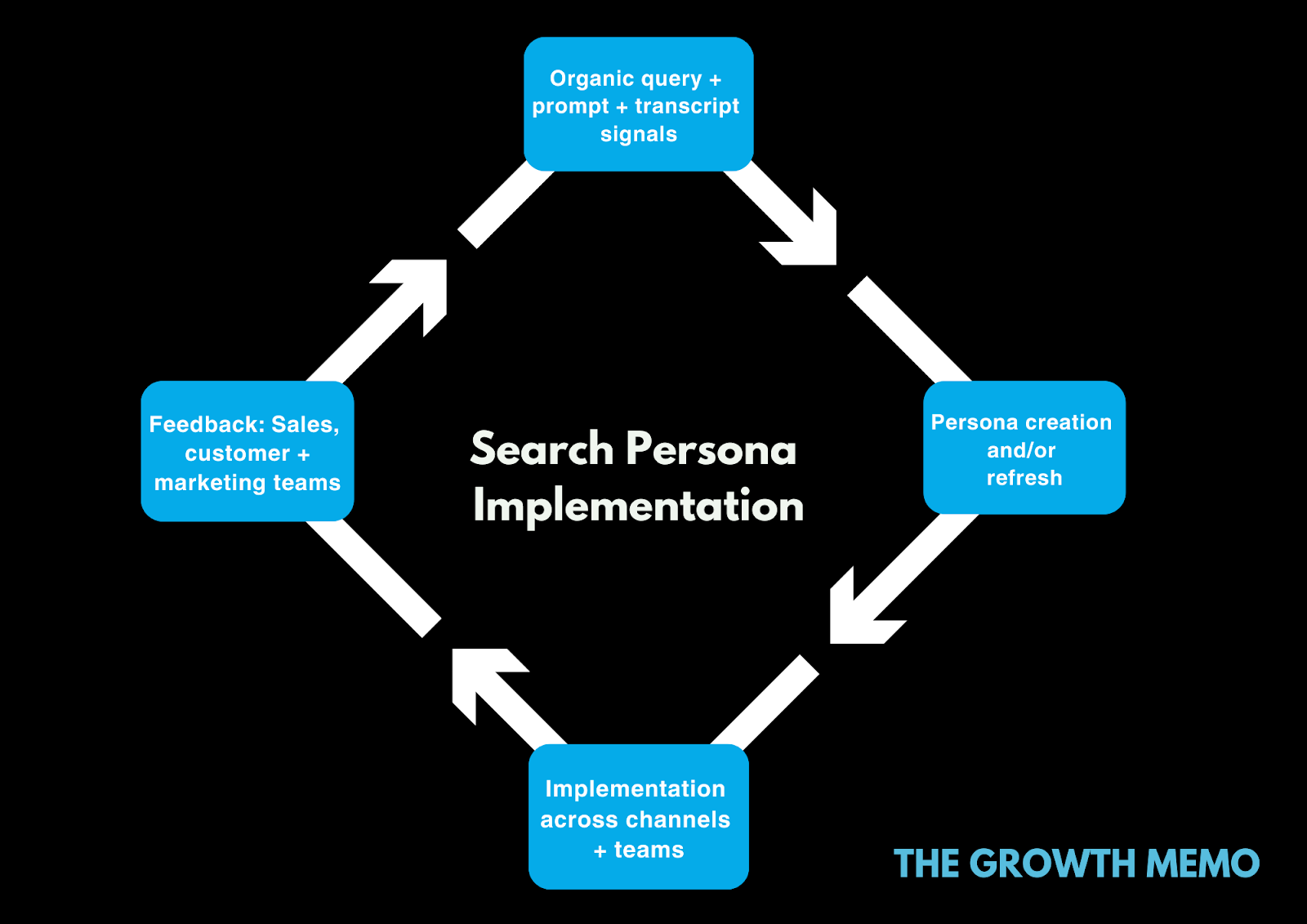 Image Credit: Kevin Indig
Here’s where your personas stop being a strategy deck or training session and start shaping what users experience.
Your search persona data is there to help you direct every brief beyond target queries and products/services features to mention.
Use it to inform your content producers of the following:
In every content brief, flag actual language from queries, call transcripts, or reviews that should be used on the page. Create a copy bank that’s tagged into your content briefs that your writers, editors, and LLMs can pull from.
For example, if your persona says “integration headaches,” don’t water it down to “implementation challenges.” Use their words.
Match the flow of the page to how specific personas are likely to consume information.
Some personas need trust-driven validation upfront (editorial quality signals, branded logos, stats, testimonials). Others need efficiency first, then a CTA.
Here’s a practical way to estimate what each of your search personas needs on the page:
Once you’re done gathering information based on user behavioral patterns, audit your on-page modules, formats, and design capabilities to ensure you have all pieces needed to create pages that fulfill those specific needs.
Enlist your product and/or web design team to create what’s needed to serve a better on-page experience.
Then, include direction in each brief of what sort of modules and information structuring is needed based on search persona type.
Specific search personas naturally gravitate toward certain topics or proof points.
A searcher who uses technical language for their queries may cluster around integrations and APIs and need to see clear documentation is available for how to use them, while a user with economic or decision-making intent may cluster around ROI topics.
Build semantically related internal linking paths that explicitly connect those journeys for your SEO personas. Use your topic map (if you’ve built one) and revisit your keyword universe as needed.
Use search persona details as inputs to LLM prompts and/or incorporate them into your AI-assisted content generation, like AirOps workflows.
Instead of “write an article about X with the search intent of Y,” frame it as “write for a skeptical buyer evaluating vendors – include comparisons and third-party validation.”
Or better yet? Use your persona cards (see Personas Are Crucial for AI Search for a detailed guide) to help guide additional prompts personas might use in LLMs when attempting to solve queries related to your brand.
Below, take a look at how this could work in practice, using the four distinct AIO intent patterns from the additional analysis of the UX study of AIOs found in Trust Still Lives in Blue Links:
Let’s say you work for a fintech startup that provides easy-to-use business insurance for small to midsize businesses.
Here’s how you might use personas to inform content production for efficiency-first and trust-driven search behaviors:
Example 1: Junior operations coordinator at a 20-person marketing agency → accepting of AIOs (efficiency-first) → queries “What’s the average cost of business insurance for a 20-person company?” → Likely to validate range via the AIO → Takeaway for your brand: Create content geared to businesses with small teams and/or junior learners that includes straightforward facts and ranges that are easily extractable, so it’s cited in AIOs. Make your pricing explanations scannable and structured. Internally link to other knowledge guides for project managers or operations leads at small to midsize businesses.
Example 2: Small business owner in healthcare services → validate AIOs with second-clicks (trust-driven) → queries “Do I need business insurance for HIPAA compliance?” → Likely to read the AIO but won’t act until they see credible signals → citations from legal/insurance authorities → Takeaway for your brand: Position your content with authoritative references (link to .gov or .org sources) and highlight compliance expertise so your page is validated by trust; include case studies and/or social proof of authority; Internally link to other guides for healthcare service businesses.
Watch for these signals:
Amanda jumping in here: In March of this last year, I led one of my clients to pivot hard to persona-focused content. Not only have we seen an increase in AIO inclusion, AI Mode citations, and LLM visibility for these niche terms, but we’ve also experienced a boost in visits to our core guides that were geared toward our broader audience. After this pivot, we’re seeing anywhere between a 20-60% month-over-month increase in organic visits from ChatGPT, and a ~40% increase month-over-month in visible AIO inclusion, to include our older core content as well. Although some of this growth is likely due to increased overall ChatGPT adoption and increase in Google’s use of AIOs across queries, here’s the takeaway (and my hypothesis): As you create niche content for personas, it’s possible you could also see a lift in your core content as it’s served to these specific groups of searchers – based on what these tools know about (1) the end user and (2) who your brand serves best. But only time (and more experiments) will truly tell.
The reality is, no matter how well you implement search personas into your SEO and content production, SEO and growth marketing teams can’t win on their own.
Search personas have the real opportunity to contribute to results when the rest of the org picks them up and runs with them throughout lead and customer touchpoints.
The trick is to make it dead-simple for every team to see why personas matter for their work and how to apply them.
Plus, a big advantage of bringing other teams on board is that SEO-driven personas – built from real search queries, prompts, social chatter, and call transcripts – arm everyone with the exact language customers use.
That means you can reduce hesitations, preemptively answer questions, and build trust across every channel of communication.
Below, here’s a quick list of guidance to help you collaborate with other teams on how to use search persona data.
And in the next section, I’ll jump into how to create intentional feedback loops so your personas stay fresh, useful, and relevant.
One of the biggest pitfalls with doing the work to create search personas is then treating them like static, lifeless relics afterward.
A 2015 B2B study conducted by Cintell found that 71% of companies who exceeded revenue goals had documented personas – and nearly two-thirds of those orgs had updated them within the last six months.
(Listen, I am well aware 2015 is approximately 47 internet years ago – but I’d argue core human decision-making behavior takes much longer to change than a decade.)
No matter the study’s age, the message rings true today: Marketing and user personas win when they’re kept alive.
SEO personas make this easier than traditional personas because they’re rooted in fluid signals, like real search queries, prompts, and customer language that evolve as quickly as the market and trends do.
If you’re closely monitoring GSC data, Semrush, or AIO/LLM interactions, you’ll see shifts in questions and pain points before most competitors.
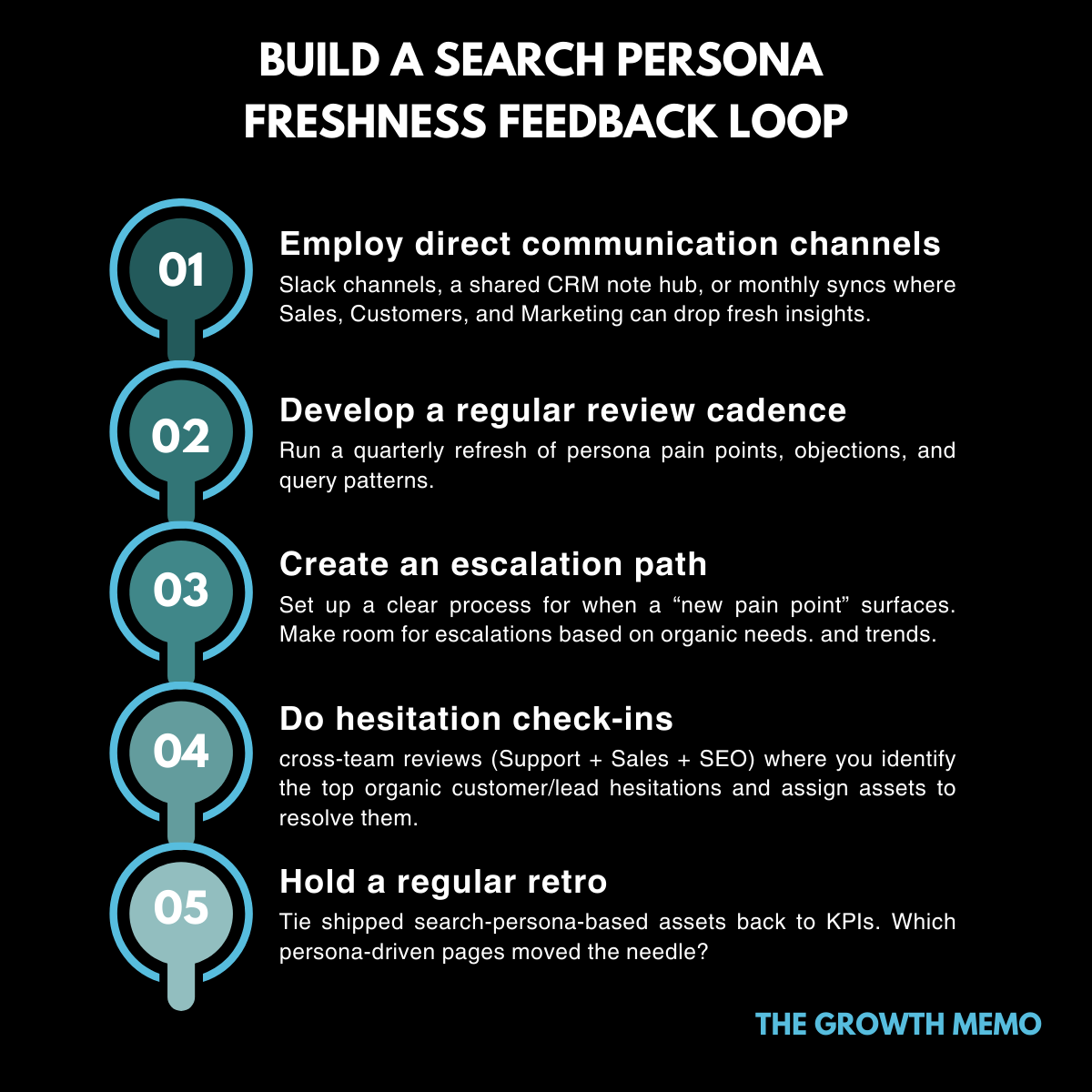 Image Credit: Kevin Indig
How to operationalize a persona freshness feedback loop across your team:
The big takeaway here is search personas are never one-and-done.
They’re a dynamic, qualitative and quantitative data-based operating system for your marketing, sales, and product teams … and if you keep the feedback loop tight, they’ll keep paying dividends.
Featured Image: Paulo Bobita/Search Engine Journal